

Introduction
The keyword 192.168.0 is related to private IP addressing used in local networks, especially home or office Wi-Fi systems. However, the address 192.168.0 alone is incomplete because IPv4 addresses must contain four numeric segments separated by dots (for example: 192.168.0.1).
In networking, 192.168.x.x addresses belong to a private IP range reserved for local networks, meaning they are not accessible directly from the public internet.
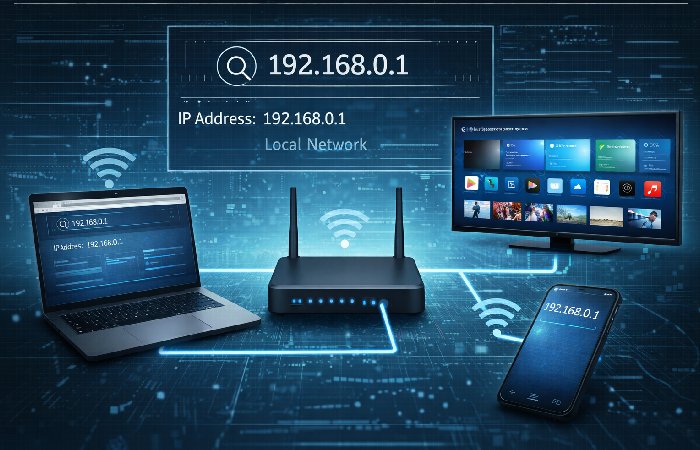
These private IP addresses are widely used by routers to communicate with devices such as computers, smartphones, smart TVs, and printers inside the same network.
What Exactly is 192.168.0?
| Attribute | Explanation |
|---|---|
| Keyword | 192.168.0 |
| Type | Private IPv4 network range |
| Category | Local network addressing |
| Internet Visibility | Not visible on the public internet |
| Common Usage | Router configuration and device communication |
| Correct Format Example | 192.168.0.1 |
| Network Block | 192.168.0.0 – 192.168.255.255 |
| Governing Standard | RFC 1918 private address space |
Private IP addresses like these allow many devices to connect to the internet using one public IP through a router using NAT (Network Address Translation).
Structure of an IPv4 Address
IPv4 addresses contain four segments called octets.
| Segment | Example | Description |
|---|---|---|
| 1st Octet | 192 | Network identification |
| 2nd Octet | 168 | Private network block |
| 3rd Octet | 0 | Subnetwork identifier |
| 4th Octet | 1 | Device or gateway |
Example valid addresses:
| Address | Purpose |
|---|---|
| 192.168.0.0 | Network address |
| 192.168.0.1 | Router gateway |
| 192.168.0.2 | Device address |
| 192.168.0.254 | Last assignable host |
| 192.168.0.255 | Broadcast address |
Private IP Address Ranges
Three major private IP ranges exist.
| Class | IP Range | Total Addresses | Typical Use |
|---|---|---|---|
| Class A | 10.0.0.0 – 10.255.255.255 | 16 million | Large corporate networks |
| Class B | 172.16.0.0 – 172.31.255.255 | 1 million | Medium organizations |
| Class C | 192.168.0.0 – 192.168.255.255 | 65,536 | Home and small office networks |
These ranges were defined by internet standards to prevent conflicts with public IP addresses.
Common Router Addresses Related to 192.168.0
Many routers use addresses within this range as their default gateway.
| Router Address | Purpose |
|---|---|
| 192.168.0.1 | Router login page |
| 192.168.0.100 | Device IP |
| 192.168.0.254 | Alternate router gateway |
| 192.168.1.1 | Another common router address |
| 10.0.0.1 | Corporate router gateway |
Routers typically take the first usable IP address in the network for management.
Router Brands Using 192.168.0.1
| Brand | Default Router IP | Admin Login |
|---|---|---|
| TP-Link | 192.168.0.1 | admin/admin |
| D-Link | 192.168.0.1 | admin |
| Netgear | 192.168.0.1 | admin/password |
| Tenda | 192.168.0.1 | admin |
| Huawei | 192.168.0.1 | admin |
How to Access the Router Using This IP
| Step | Action |
|---|---|
| 1 | Connect device to router Wi-Fi |
| 2 | Open a web browser |
| 3 | Enter 192.168.0.1 in address bar |
| 4 | Enter router username and password |
| 5 | Access router dashboard |
You can learn more about IP addresses and networking concepts here:
Learn about IP Address Basics
Why 192.168.0 Alone Does Not Work
| Input | Result |
|---|---|
| 192.168.0 | Invalid IP |
| 192.168.0.1 | Router login |
| 192.168.0.256 | Invalid range |
| 192.168.0.O | Letter used instead of number |
IPv4 addresses must always contain four numeric sections, otherwise browsers cannot interpret them correctly.
Growth of Connected Devices in Home Networks

Key Uses of the 192.168.x.x Network
-
Home Wi-Fi networks
-
Office LAN systems
-
Smart home device communication
-
Printer and server networking
-
Router configuration
Advantages of Private IP Addresses
-
Improved network security
-
Reduced global IP address usage
-
Easier device management
-
Ability to create large internal networks
Usage of Private IP Networks
Comparison: Public vs Private IP
| Feature | Private IP | Public IP |
|---|---|---|
| Internet Access | Local network only | Global internet |
| Example | 192.168.0.1 | 8.8.8.8 |
| Assigned By | Router | Internet Service Provider |
| Security | More secure | Exposed to internet |
| Accessibility | Internal devices | Anyone online |
Troubleshooting Common Router Login Issues
| Problem | Cause | Solution |
|---|---|---|
| Router page not opening | Wrong IP | Check gateway IP |
| Login failed | Incorrect password | Reset router |
| Page timeout | Network issue | Restart router |
| Browser redirect | Typo in IP | Re-enter correct IP |
Conclusion
The keyword 192.168.0 represents part of a widely used private IP address range used in local networks. Although it is not a complete address by itself, it forms the base of common router addresses such as 192.168.0.1, which act as gateways for managing home and office networks.
Private IP systems make modern internet usage possible by allowing dozens of devices—phones, laptops, smart TVs, and IoT gadgets—to share a single internet connection safely. Understanding how these addresses work helps beginners troubleshoot network problems, configure routers, and build efficient local networks.
FAQs
What is 192.168.0 used for?
It represents a part of the private IP address range used in local networks. Routers and connected devices typically use addresses starting with 192.168.x.x.
Why does 192.168.0 not open a router login page?
Because it is incomplete. IPv4 addresses must contain four segments such as 192.168.0.1.
Is 192.168.0 a public or private IP address?
It belongs to the private IP address range reserved for local network communication.
Which routers commonly use 192.168.0.1?
Routers from brands like TP-Link, Netgear, Tenda, and D-Link often use this address as the default gateway.
Can devices outside my network access 192.168.0 addresses?
No. Private IP addresses are not accessible from the public internet and only work within local networks.
